The post Baby Died After Contracting Herpes Virus From Kiss appeared first on PregnancyBeyond.
]]>Baby Died After Contracting Herpes Virus From Kiss:
A newborn baby died after catching herpes from a ‘kiss of death’, her heartbroken mother has revealed.
The parents of a newborn baby who died just eight days after her birth are warning others. About the potential dangers of allowing family and friends to touch and kiss infants.

Aliza Rose Friend was just eight days old when she passed away after developing neonatal herpes. Her mother Abigail says Aliza was healthy for the first 36 hours of her life before she developed a fever.
4D ULTRASOUND CAPTURES TWIN BABIES KISSING INSIDE MOM’S WOMB
The newborn baby began to deteriorate as the disease quickly “ate her lungs and brain”. Leaving her struggling to breathe and suffering multiple seizures.
The DailyMail reports that the baby was soon declared brain dead. Doctors turned off her life-support while her mother sang ‘you are my sunshine’

HSV-1 typically causes cold sores or small blisters on the mouth, eye, or lips, which can lead to severe infections or even death in newborns due to their undeveloped immune systems. According to the New York State Department of Health, about 70 percent of U.S. adults are infected with HSV-1 and can shed virus in their saliva at any time, even if they don’t show symptoms. The virus can be transferred to newborns from close contact with someone who is shedding HSV-1 or has an active outbreak.

Her mother Abigail Rose Friend was told by doctors her daughter caught the infection after being kissed by a carrier or touched by unwashed, contaminated hands. Due to her having many visitors, it is unclear who passed the virus on.
DAD WARNS OF DANGERS OF DRY DROWNING AFTER 4-YEAR-OLD’S DEATH
Join us over at the PB Moms Exclusive Circle, where we invite healthcare experts to prepare us for life after childbirth and motherhood. Go to: pregnancybeyond.com/exclusive-circle.
Follow PregnancyBeyond on Instagram, Facebook, and Twitter.
The post Baby Died After Contracting Herpes Virus From Kiss appeared first on PregnancyBeyond.
]]>The post Breastfeeding Your Newborn: What To Expect appeared first on PregnancyBeyond.
]]>Breastfeeding Your Newborn:
Breastfeeding Your Newborn: What To Expect, By Miri Sais.
As a birth attendant, I’ve spent over 20 years helping women learn about breastfeeding. The truth of breastfeeding is vast. It’s impossible to brief in one, or even two, articles. It does not simply latch on, latch off. It is a science and an art. One that requires true dedication and patience. That said, never is it something you should fear. There is nothing of breastfeeding that lacks explanation, and once you have the fundamentals you’re already on the right path.
The base fundamentals of breastfeeding are universal, it is important to remember that every mother and child situation is different.
The Three Stages of Breast Milk
To understand breastfeeding you must first understand breastmilk; which “comes in” three stages. Which are colostrum, transitional milk, and mature milk.
Colostrum:
This thick yellow (sometimes clear) substance comes in first. Commonly, the production of colostrum starts half or third into pregnancy. Like most good things colostrum comes in a small dosage. At most, babies only get 1-2 tablespoons of colostrum per feeding. Still, even a few drops of this miracle liquid is more than enough. This mighty mountain does everything, from supplying immune-building antibodies, to help a baby adjust to life outside of the womb by regulating bodily fluids.
Transitional milk:
Days after giving birth your milk will turn white. Easily explained, transitional milk is the combination, and this transition, of colostrum to mature milk. Its main purpose is gradually preparing your baby for mature milk.

Mature milk:
After several weeks you will arrive at your final stage. Mature milk is explained in two parts: foremilk and hindmilk. Over the course of every breastfeeding session, mature milk will change from thin and watery, foremilk, to thick and creamy, hindmilk. Foremilk comes first, low in fat but high in volume and nutrition. However, the more your baby eats the volume lessens, and fat gains, this change is called “hindmilk”.
It is important to note, foremilk and hindmilk are NOT two different types of breastmilk. Rather they are two combining qualities. Neither being more important than the other. Both are key to happy healthy babies. So please do not be confused by hindmilk being fattier. Foremilk is just as vital as it is packed with brain-building nutrients.

Now that you have an idea of how breastmilk works, it’s important to know what steps to take.
Engorgement & Breast Fullness
During the transitional stage you will notice your breast starting to enlarge, likely they will feel a bit tender, and perhaps a bit swollen. This is perfectly normal. Your body is filling your breast with milk.
Not to be confused with engorgement, which is what happens when your body produces too much milk. Instead of tender, when engorged your breast becomes painfully hard. Long term engorgement can lead to severe problems, you can even catch fevers and infection. Engorgement can lead to Mastitis. Please take preventative measures to avoid this.
Gratefully, there are ways to both prevent and treat engorgement:
To Prevent
 Do not delay. Make sure you feed your baby when he/she is hungry. Or else your milk supply will just continue to grow.
No rushing. When feeding makes sure your baby has reached his/her fullness before unlatching.
Wear a bra. This is 100% vital, you must wear a supportive bra.
Make sure to rotate each session (keep in mind the hindmilk can be lost in too much rotation. this is where the art of breastfeeding comes in)
To Treat
Massage your breast: a gentle massage before and during breastfeeding will help decrease pain and better your milk flow.
Apply heat: A warm shower or applying a warm rag to your breast before feeding should better your milk flow.
Cold cabbage: To decrease pain and internal swelling, wrap your breast in cold cabbage leaves.
HOW TO STRENGTHEN YOUR PELVIC FLOOR MUSCLES AFTER PREGNANCY
Latching
A proper latch encompasses the entire nipple and some of the areola (the darker area of your breast around your nipple). The exact amount of your areola that the baby should have a latch on, differs for different size breasts and areola. One inch or more of your areola should be in your baby’s mouth to make a good latch.

Here are some ways to identify poor vs proper latch:
Poor Latch
The mouth is barely open
Tongue behind lower gums
Lips are curled in
Chin barely brushes breast
Proper latch
Chin touches breast
The tongue is over the lower gums
Lips are curled out, slightly like a fish
The mouth is opened wide like a yawn
Nutrition
The beauty of breastmilk is it takes all the nutrition from the mother’s food and delivers it to the baby. However, eating food lacking nutrition means breastmilk is lacking viable substance. When nutrition is lacking often babies won’t even want to breastfeed. Which can lead to the baby staying up at night. Breastfeeding is an investment of dedication and nutritional education. I assure you it is worth it and the effects are generational longevity.

You are building strong bones (which don’t stop growing until the age of 21) along with an intelligent brain. Not only for your child but for your grandchildren and their grandchildren. By breastfeeding your child you literally blaze a trail for strong generations to come.
There’s no cheat sheet or shortcut to breastfeeding. It is the first food and one of the first forms of love you’ll share with your child. So cherish each moment and know your bond is stronger with each session.
FEVER AFTER BREASTFEEDING, TREATMENT, AND PREVENTION
About the Author :
 Miri Sais is a Traditional Birth Attendant, Prodigy Entrepreneur, and a Certified Market Garden Trainer. She is 2nd generation home birthing babies.
Miri has helped hundreds of families in her 20+ years as a birth attendant and doula and has personally ushered the births of hundreds of healthy babies into the world. She has also guided countless human beings to heal from emotional pain, grief, miscarriage, inner stress, and trauma, tap into their strength and power, live fully and live vibrantly, and reclaim their radiance, joyfulness, calm and overall sense of well-being. She teaches empowered birth which has the ability to heal the soul and awaken the most enlightened version of ourselves. Find more of her on www.Mirisais.com, on her Facebook page, and on her Instagram page.
Join us over at the PB Moms Exclusive Circle, where we invite healthcare experts to prepare us for life after childbirth and motherhood. Go to: pregnancybeyond.com/exclusive-circle.
Follow PregnancyBeyond on Instagram, Facebook, and Twitter.
The post Breastfeeding Your Newborn: What To Expect appeared first on PregnancyBeyond.
]]>The post Solly Baby Wraps – Product Spotlight appeared first on PregnancyBeyond.
]]>Solly Baby Wraps:
Solly Baby wraps were founded in 2011 by Elle Rowley, an entrepreneur extraordinaire and a mom of four. The wraps are designed for the baby’s first year of life, and or up to 25 pounds. Made in the USA and made of 100% Lenzing Modal Botanic Fibers, the Solly Baby wrap is light and airy to keep the baby at a cool temperature, which is beneficial all year long.
Solly Baby wraps are so incredibly soft against mom’s and baby’s skin — And when you are ready to wash, just throw it in the washing machine with your other baby laundry. Each Solly Baby is one size fits all and you can even get FREE SHIPPING in the USA and a $10 flat fee for International Shipping. Plus, $1 of EVERY wrap purchased helps make a safe birth for a mother around the world in association with their Every Mother Counts campaign. To learn more about this nonprofit organization, click here http://sollybaby.com/every-mother-counts/
Each Solly Baby wrap comes with step by step booklet with instructions on how to properly tie and wrap your baby. If you need more help, watch this informative video by TV Star and mom blogger – Natalie Nunn
https://instagram.com/p/BlBaXD9hzAM/
You can also check out a tutorial on how to breastfeed your baby while he or she is in the wrap, here http://sollybaby.com/information/#tutorials
Here are some tips for safe babywearing:
- Use the T.I.C.K.S. Rule – T: Tight, I: In View at All Times, C: Close Enough to Kiss, K: Keep Chin off the Chest, and S: Supported Back. Babies, especially newborns, have a real threat of suffocation. So always keep these tips in mind for the safety of your child. Follow all of the directions for the correct way to wrap your baby and how your baby should be facing.
- Do not drive with your baby wrapped
- Do not cook with your baby wrapped
- Also, do not drink hot liquids (coffee, tea, soup) when you are wearing your baby
- If you need to pick something up, bend at the knee and do not bend over forward. I also suggest holding your baby’s head for extra security whenever you are not sitting or standing straight.
To follow Solly Baby on Instagram click here https://www.instagram.com/sollybabywrap/And on Facebook here https://www.facebook.com/sollybaby/
Shop the wrap here
And do not forget to take a picture of your baby in your Solly Baby and tag #sollybaby!
.
Sponsored Post
Join us at the PB Moms Exclusive Circle. Where we invite healthcare experts to prepare you for life after childbirth and motherhood. Go to: pregnancybeyond.com/exclusive-circle.
Follow PregnancyBeyond on Instagram, Facebook, and Twitter.
The post Solly Baby Wraps – Product Spotlight appeared first on PregnancyBeyond.
]]>The post ICP : “My Story Could Have Ended in Tragedy” appeared first on PregnancyBeyond.
]]>ICP:
“My Story Could Have Ended in Tragedy” By Tenauh Lopez (ICP Care).
June is ICP (Intrahepatic Cholestasis of Pregnancy) Awareness Month, ICP is a medical condition where women experience a very severe itching during pregnancy. PregnancyBeyond has teamed up with ICP Care. To raise awareness of this liver disorder. That develops during pregnancy. In which bile flow is impaired within the liver itself. This condition has been shown to pose a serious risk to the unborn baby.
In today’s post, one mom emphasizes the importance of raising awareness of this pregnancy-specific liver disease.
.
 My story began in 2012, I got married and we wanted kids as soon as possible. We started to try and conceive. I found out on the eve of my wedding that I was pregnant. We were super excited to start our new lives together and raise our future children. Unfortunately, the next day I woke up to heavy bleeding and took another pregnancy test which came back negative. My mother-in-law took me to the emergency room to verify that I had a miscarriage. We were deeply saddened that I had lost the baby. I knew it would happen at the right time. For the next couple of years, we consistently tried to get pregnant and failed. We visited many specialists and fertility doctors.
The test results showed that he had a lot of fertility problems and we would most likely need to do IVF in order for me to become pregnant. I also have Neurogenic Cardiac Syncope and was told I would not be able to have a child naturally. Ultimately, if I was able to conceive it would be a high-risk pregnancy that I would most likely be on bed rest my whole entire pregnancy.
At this time there was a lot of stress and we ended up getting divorced.
After my divorce, I became very depressed and thought I would never have the opportunity of becoming a mother and did not think it was possible due to previous miscarriages and my medical condition. After consistently trying for six years nothing happening you get very doubtful. In 2017, I decided if it doesn’t happen this year naturally I would save up for IVF. I wanted to try one round of it and if it failed my plan would be to adopt.
I was engulfed in my job and living life. Out of the left-field, I started feeling really nauseous. After so many negative pregnancy tests I thought I got a stomach bug. Then I remembered I was late on my period but only a day late and I really didn’t think much of it. Finally, it bothered me so much that I just went and bought a pregnancy test thinking it would be negative. Low and behold the test came back positive.
 I was over the moon excited but worried that I would have a miscarriage again. I had my HCG test every week and I prayed that my numbers were rising and not falling. Further, I didn’t tell anyone that I was pregnant until I reached four months of pregnancy. My dad was the first one I told and he was in utter shock. Because he remembers the call we had a couple of months before. Telling him that I was really seriously considering doing one IVF treatment and adopting.
Around 4 months, I went to the doctor just for a general check-up because I started itching and sneezing. I thought it was just my seasonal allergies. I was taking Benadryl but it wasn’t helping. Also, I got bit by some ants at work and I am allergic too. I just thought it was just a reaction to that. It concerned me though since I was still itching 7 days after I got bit. I noticed that I started itching really bad at night to the point that it was keeping me awake.
My general doctor went on to tell me that during pregnancy this could be something serious with my liver. This scared me a lot and it concerned me knowing how it could affect my unborn baby. He drew blood and ran a blood test to check my bile acids. My OBGYN called me the same day and said to come in because he had drawn blood to do the wrong test. I was deeply
confused. She explained to me that there are two tests. One is to check your levels if you are not pregnant and the other checks your levels when you are pregnant because they vary.
At this point in time, I asked her what is the medical name for this condition that was going on with my liver. She told me Intrahepatic Cholestasis of Pregnancy or ICP. I was on pins and needles while I waited for my test to come back so I googled ICP. The first thing that came up in my search was a music band that paints their faces like clowns. I knew instantly that cannot be the right abbreviation. So I researched the medical name Cholestasis and found a support group ICP Care with a lot of information about this high-risk pregnancy.
A couple of days later my doctor called me back to let me know that I had a diagnosable bile acid level and I would need to start the medicine to treat ICP called Ursodiol. I don’t know which was worse the itching or the medication. My daughter needed monitoring with weekly non-stress test and biophysical profile ultrasounds. Another important part of treatment is early induction. My levels were high enough requiring me to be induced at 36 weeks.
During her biophysical profile ultrasounds, it showed she was measuring two to three weeks smaller than she should be. She measured 4 lbs 2 oz at my last ultrasound. My doctors prepared me for the possibility of her being in NICU for an extended amount of time. Also, they were afraid that her lungs may not be mature enough for her to breathe on her own. Their plan was to give me two steroid shots for lung maturity before induction.
Even with this added stress, I continued to work all the way up until the day I was induced. I started my induction on 3/12/18 at 7:00 am in morning. Lilac May Walker arrived weighing 4 lbs 6 oz at 11:52 pm on 3/13/18. Lilac defied all odds and regulated her temperature, breathing, and blood sugars all by herself. This meant she did not need any NICU time.

After she arrived, I stopped itching momentarily enough to see the scars that were left on my body from itching. After 3 days postpartum the itching returned and is still prevalent which is likely cyclical even though my bile acids are within in range.
Since my experience with Cholestasis of Pregnancy, I will continue to advocate to spread awareness about this condition with high risks for the baby. Many women still go untreated and undiagnosed. Fortunately for me, I asked questions and went to the doctor. If my story in any way will help save lives and create awareness I will continue. My story could have ended in tragedy. But I was lucky enough to be surrounded by a team of physicians, who were educated about the high risks. (Find more info. on ICP here)
READ: HOW ICP CHANGES YOUR PREGNANCY
The ICP Care:
ICP Care is a 501(c)(3) nonprofit determined to help pregnant mothers who experience Intrahepatic Cholestasis of Pregnancy and to deliver healthy babies. ICP Care’s mission is to provide patient support and education. Raise public awareness, support the advancement of research, and improve health care practices. ICP Care helps to connect, support, educate, and empower those affected by ICP – Intrahepatic Cholestasis of Pregnancy.
We do this by raising awareness of the condition, distributing educational materials for patients and medical professionals, and creating a supportive community for friends and families of anyone affected by ICP. We hope that one day, all medical professionals and staff will know the proper protocol for treating Intrahepatic Cholestasis of Pregnancy, resulting in less suffering and healthier ICP babies. Find them on Facebook and at www.icpcare.org
Join us over at the PB Moms Exclusive Circle, where we invite healthcare experts to prepare us for life after childbirth and motherhood. Go to: pregnancybeyond.com/exclusive-circle.
Follow PregnancyBeyond on Instagram, Facebook, and Twitter.
The post ICP : “My Story Could Have Ended in Tragedy” appeared first on PregnancyBeyond.
]]>The post Baby Milk Formula – Global Recall Over Salmonella Fears appeared first on PregnancyBeyond.
]]>Baby Milk Formula:
Global Recall Of Baby Milk Formula Over Salmonella Fears.
December 11, 2017

Photo: Bob Edme, AP
French baby milk formula maker, Lactalis has ordered a worldwide product recall over fears of salmonella contamination.
The French company, one of the world’s largest dairy groups said it was warned by health authorities in France that 26 infants under six months of age have become sick since early December and had been diagnosed with Salmonella infection. The recall covers hundreds of baby milk powder products marketed globally under the Milumel, Picot, and Celi brands.
Lactalis said in a statement through his spokesperson Michel Nalet that the “precautionary” recall involves “several million” products made since mid-February and believes the salmonella outbreak can be traced to a tower used to dry out the milk powder at its factory in the town of Craon in northwest France.
According to Agence France-Presse AFP, the company is unable to say currently how much of the products remain on the market, have been consumed, or are in stock.
The company said it is “sincerely sorry for the concern generated by the situation and expresses its compassion and support to the families whose children fell ill.” It also said precautionary measures have been taken to disinfect all of its machinery at the suspected site in western France.
The symptoms of salmonella infection include abdominal cramps, diarrhea and fever, and vomiting.
Most people recover without treatment, but the very young, as well as the elderly and people with compromised immune systems, have a greater risk of becoming severely ill and the dehydration caused by the illness can be life-threatening.
The United States, a major market for Lactalis, is not affected, according to information published on the French health ministry’s website. However, the recall affects products and exports to countries including Britain, China, Pakistan, Bangladesh, and Sudan.
If your country is affected, you are expected to stop using the product immediately.
ALSO SEE: MOM SAYS PRESSURE TO BREASTFEED LED TO ACCIDENTALLY STARVING HER BABY
Join us over at the PB Moms Exclusive Circle, where we invite healthcare experts to prepare us for life after childbirth and motherhood. Go to: pregnancybeyond.com/exclusive-circle.
Follow PregnancyBeyond on Instagram, Facebook, and Twitter.
The post Baby Milk Formula – Global Recall Over Salmonella Fears appeared first on PregnancyBeyond.
]]>The post Benefits Of Delayed Blood Clamping For Your Baby appeared first on PregnancyBeyond.
]]>Benefits Of Delayed Blood Clamping:
Benefits Of Delayed Blood Clamping For Your Baby, By Natasha Burgert, MD, FAAP (@doctornatasha).
Following the 2017 American Academy of Pediatrics (AAP) National Conference, Dr Natasha Burgert (@kckidsdoc) shares some key information that emerged from the recently concluded conference.
What You Need to Know About Delayed Cord Clamping
You’ve rejoiced at the two lines on your home pregnancy test. You’ve watched your baby grow from the size of kiwi to a watermelon. You’ve felt first kicks and hiccoughs. Gender reveals, baby registries, baby showers… You’ve done it all!
Throughout these months of excitement and anticipation, your baby has been connected to your body by an umbilical cord. This slippery, thick “rope” is a literal lifeline, containing two arteries (carrying waste products away from the baby to the placenta) and one vein (returning oxygen-containing blood to the baby) to perform this vital job. At the time the baby is born, the umbilical cord is clamped and cut as baby begins his or her new life as an independent human.
Traditionally, the umbilical cord is clamped and cut less than a minute after a child is born. Recent research has challenged this practice, however, suggesting that allowing the cord to remain intact and untouched for 3-5 minutes after delivery may have benefits to the new infant. In fact, the American Congress of Obstetricians and Gynecologists supports delayed cord clamping for all healthy newborns.
Delayed Cord Clamping (DCC ) has shown numerous benefits to the newborn. It allows time for more oxygen-rich placental blood to return to the baby before cord cutting; resulting in baby receiving more red-blood cells, more iron, and more stem cells before separation. In addition to the potentially easier transition to living outside the womb, this extra blood decreases the risk of both anemia in infancy the risk of needing blood transfusions.
The cool part? The benefit of DCC may extend past the infancy period. One study followed infants for four years after using DCC during delivery and found improved fine motor and social skills relative to non-DCC peers. This neurocognitive benefit was seen more in baby boys than baby girls.
So why wouldn’t you want DCC for your baby? Studies suggest that the benefit of DCC is most significant in preterm babies and babies in developing countries. For women delivering in well-resourced areas, some argue healthy term babies don’t need the extra boost. Also, DCC does not allow for healthy babies to significantly contribute to stem-cell donation. Donated stem cells are responsible for saving lives of children in need of life-saving medical interventions. Many families choose to donate umbilical cord blood rather than opt for DCC.
Although DCC is possible for both vaginal and caesarian births, it’s important to remember that not all birth experiences go as planned. For babies needing additional support at the time of birth, delayed clamping is likely less important than other urgent life-support measures. Alternatively, DCC may not be in the best interest of a mother’s health if excessive bleeding occurs at delivery, or has other chronic illnesses.
Talk to your doc about your preference for delayed cord clamping. Make the decision together on your baby’s birthday to determine what is best for both you.
Congratulations and good luck!
RECOMMENDED : IMPORTANT THINGS FIRST -TIME MOMS SHOULD KNOW
About the author: Dr. Natasha Burgert is a board-certified pediatrician in Kansas City, MO and spokesperson for the American Academy of Pediatrics. She shares evidenced-based child health information blended with her experience as a mom of two on KCKidsDoc.com. You can also find her on Facebook, Instagram, and Twitter.
Join us over at the PB Moms Exclusive Circle, where we invite healthcare experts to prepare us for life after childbirth and motherhood. Go to: pregnancybeyond.com/exclusive-circle.
Follow PregnancyBeyond on Instagram, Facebook, and Twitter.
The post Benefits Of Delayed Blood Clamping For Your Baby appeared first on PregnancyBeyond.
]]>The post Sudden Infant Death Syndrome – Prevention Guide appeared first on PregnancyBeyond.
]]>Sudden Infant Death Syndrome:
Sudden Infant Death Syndrome – Prevention Guidelines, By Natasha Burgert, MD, FAAP (@doctornatasha),
Following the 2017 American Academy of Pediatrics (AAP) National Conference, Dr Natasha Burgert (@kckidsdoc) shares some key information that emerged from the recently concluded conference.
A SIDS Primer: Sleep Well. Sleep Safe.
There is nothing more terrifying for any family than the thought of infant loss. Sadly, despite increasing education on SIDS-prevention practices, the rate of sudden infant death is climbing in the US. This is concerning for those of us who devote our lives to child health because many of these deaths are preventable.
Researchers believe that the increasing death rate is partly due to families choosing to avoid safer sleep guidelines. Evidence suggests that although many parents know the safer way to sleep, some families “give up” on these practices because of parental fatigue, anxiety, or desperation for baby to sleep. Other parents don’t follow safer practices because they falsely believe SIDS is not preventable, and the guidelines won’t change a baby’s “fate.” A smaller group may be relying on products falsely marketed for SIDS-protection.
Here’s the reality: Creating a safe sleep environment and making the decision to follow through with your safe sleep plan, even when times get tired and tough, are the very best things you can do to prevent your new little one from suffocation.
The goal for all families should be quality sleep. For babies, this means back to sleep for every sleep, even when in the hospital after delivery. And after the baby comes home, it’s essential to create a safe sleeping environment based on the scientific evidence we know is protective. Finally, SIDS prevention is also about choosing healthy habits to support a loving and nurturing environment as your baby sleeps and grows.
Learn and follow these SIDS-prevention tips:
1 Back to sleep. Every sleep. Baby should be sleeping on her back, never on her belly.
2 Boring and bare. Baby’s sleep environment should be a simple flat, firm mattress with a tight-fitting sheet. No bumper pads. No blankets. No toys. No cords from monitors should be in the sleep space.
3 Room share. Baby should be in her sleep space in the same room where your sleep, but never in the sharing the same bed.
4 Breastfeed. If you are able, choose to breastfeed to nourish your baby.
5 Pacifiers are OK. Once breastfeeding is established, putting baby to sleep with a pacifier is shown to decrease SIDS.
6 Vaccinate. Routine vaccinations are protective against infant death.
7 Don’t smoke. Keep baby away from others who smoke, and places where people smoke.
And remember:
It’s OK to wake. A healthy infant should wake periodically throughout the night for comfort and feedings. Sleeping “through the night” should not be an immediate expectation.
• Even babies with reflux can safely sleep on their backs.
• If you are sleepy, it’s safer to feed your baby in a bed free of all blankets and pillows, than to feed on a cushioned couch or chair. If you do fall asleep while feeding, move baby to her safe sleep space as soon as you wake.
Safe sleep is hard, but the commitment to safety is easy. If you follow the evidence-based suggestions for baby’s safer sleep, everyone can rest easy knowing you have done your best to protect baby from needless risk.
Sweet dreams!
RECOMMENDED : HOW TO GET BREASTFEEDING OFF TO A GOOD START
About the author: Dr. Natasha Burgert is a board-certified pediatrician in Kansas City, MO and spokesperson for the American Academy of Pediatrics. She shares evidenced-based child health information blended with her experience as a mom of two on KCKidsDoc.com. You can also find her on Facebook, Instagram, and Twitter.
Join us over at the PB Moms Exclusive Circle, where we invite healthcare experts to prepare us for life after childbirth and motherhood. Go to: pregnancybeyond.com/exclusive-circle.
Follow PregnancyBeyond on Instagram, Facebook, and Twitter.
The post Sudden Infant Death Syndrome – Prevention Guide appeared first on PregnancyBeyond.
]]>The post Cancer While Pregnant – Photos of New Mom appeared first on PregnancyBeyond.
]]>Cancer While Pregnant
Cancer While Pregnant – Beautiful Photos of New Mom Breastfeeding After Mastectomy.
In honor of Breast Cancer Awareness month, DeShonjla “Shonni” Peterson, 40, got diagnosed with breast cancer while pregnant in November 2016. She was only in her first trimester shares her emotional story with us.
In all began in October 2016 when DeShonjla “Shonni” Peterson found a lump in her breast, shortly after, on November 22, 2017, DeShonjla got diagnosed with Stage 1 breast cancer “who knew that during breast cancer awareness month I would discover that I had breast cancer?”
Fastword to the day she was scheduled to have a double mastectomy, DeShonjla discovered she was pregnant! Left with two choices, her breast surgeon suggested she terminated the pregnancy and treat the cancer or continue with the pregnancy and delay treatment.
DeShonjla and her husband Kevin made the decision to protect their unborn child. So they kept the pregnancy “If I choose to start chemo today, I risk something possibly harming Zoe . While there are plenty of chemo babies out there, there isn’t enough evidence to support me risking any additional part of her health.” she said in a blog post.
At week 20 of her pregnancy, on April 7, DeShonjla had a single mastectomy “If I did the bilateral and with reconstruction my baby would be under anesthesia for close to 5 hours and I couldn’t risk that so I went with the lesser of the evils and only had one removed”.
Monday July 31, 2017, DeShonjla “Shonni” Peterson welcomed a healthy baby girl, Zoe Jade and photographer Nceephotography was there to capture the birth and take photos of DeShonjla breastfeeding her newborn. “I couldn’t be more ecstatic to meet her” the proud new mom said.

DeShonjla wrote on Instagram
“Vulnerable is one of those things that I never wanted to be. Vulnerability always equated to weakness to me. Any vulnerability was calculated to make myself feel and look more human. Now as I sit today, transparent in my thoughts and emotions about this journey I feel nothing but strength and relief from my vulnerability. I feel beautiful in this space. This outward body is not where my beauty is housed. It is well within and courses through every fiber of my being. I share this image as another level of vulnerability and transparency. I don’t owe anyone this, but this is where my beauty now resides. It resides in everything I do. It resides in everything I am. It resides in everything I am affiliated with. It resides in everything that I love. Thank you all for walking on this journey with me.”
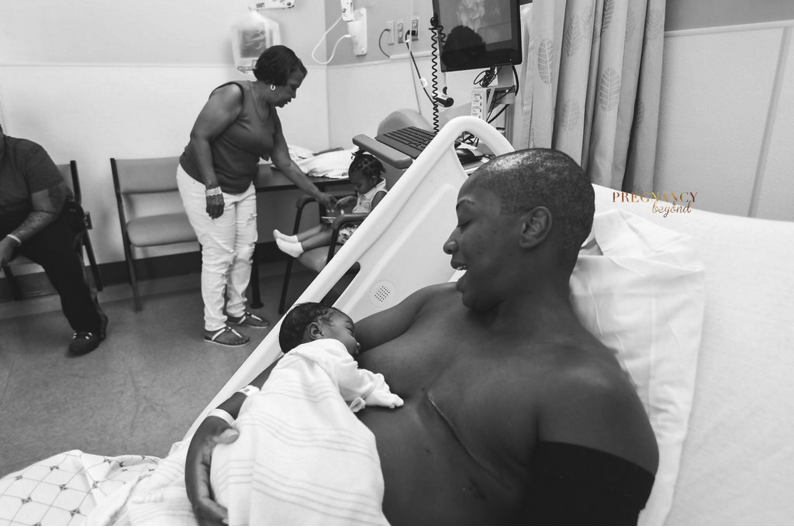


DeShonjla has since started chemotherapy after she was able to nurse her daughter for about three weeks.
Please continue to put DeShonjla“Shonni” Peterson in your prayers. “This time next year all of the words from this video will come to pass and I claim that!!! We are going to celebrate, exclaim, and boogie down to the ground next year because God’s promise of healing will be manifested and realized. Y’all can STAMP THAT!!! This tale will end happily ever after. Love, life and health will prevail.”
Praying for her victory over this horrible thing called cancer!
SEE ALSO: MOM GIVES BIRTH TO TWINS TWO WEEKS APART
Find more of DeShonjla on Instagram and on her blog.
Photography: Nceephotography
Join us over at the PB Moms Exclusive Circle, where we invite healthcare experts to prepare us for life after childbirth and motherhood. Go to: pregnancybeyond.com/exclusive-circle.
Follow PregnancyBeyond on Instagram, Facebook, and Twitter.
The post Cancer While Pregnant – Photos of New Mom appeared first on PregnancyBeyond.
]]>The post “We Beat Infertility”: Woman’s Near Death Experience appeared first on PregnancyBeyond.
]]>We Beat Infertility:
“We Beat Infertility”: Woman Recounts Her Near-Death Experience

A year after her daughter was born at 25 weeks gestation, the mama of one Jules Paige recounts how she nearly died when a driver hit her, in a head-on collision while pregnant with her miracle baby, Juliana.
She wrote on Instagram:
“This is us then. 1 year ago tomorrow we were hit in a head on collision by a driver that fell asleep at the wheel. After 10yrs of trying to have a baby Juliana was my miracle. She was born via emergency c-section at 25 weeks. My placenta was abrupted by 70 percent & my uterus was filled with blood. Our doctor said it’s a miracle we both survived. God definitely had us covered. In this photo my husband and I were both headed into surgery at the same time. His whole leg was crushed including his femur. Our nurses brought us together as we prayed and chose a name for our baby girl. We asked the doctors to please give our baby a fighting chance no matter what. We’ve come a long way in a year and we’re so excited to share all the changes in a special family post tomorrow. Thank you to everyone who has prayed for our family, watched Juliana grow and cheered us on. It means more than you guys will ever know. We’re blessed & grateful.  ”

Speaking to pegnancybeyond.com, Jules says holding Juliana for the first time was magical. “I waited 18 days to hold her.. I was nervous because she was so tiny. That feeling quickly went out the window and I couldn’t stop smiling. It felt so good to have my tiny fighter skin to skin. All these feelings quickly turned into tears. I was overwhelmed with happiness.”
Narrating the first moments with her daughter, Jules described how she had to put Juliana back into her isoletter 5 minutes after holding her “She was still critical and fighting for her life. She couldn’t adjust and started having bradycardias and low oxygen. I was sad that she didn’t last longer but I wanted what was best for her. She stabilized better once she was back in her isolette”.
..
Jules went on to describe how she felt when she became a mom for the first time. “Thinking about the way I became a mom for the first time makes me overwhelmed. I can’t describe the feeling except for I’ve never been so in love. Things didn’t go the way we planned but I’m glad I’m here to witness my miracle grow up. She is everything to me.”

Thank you for sharing your story and best wishes to you and your family.
SEE ALSO:- PREGNANT WITH CANCER – BEAUTIFUL PHOTO OF MOM BREASTFEEDING AFTER MASTECTOMY
12 Cute And Funny Onesies For Your Baby
Follow Pregnancy & Beyond on Instagram, Facebook and Twitter
The post “We Beat Infertility”: Woman’s Near Death Experience appeared first on PregnancyBeyond.
]]>The post Woman Gives Birth While Shopping At Target appeared first on PregnancyBeyond.
]]>Woman Gives Birth While Shopping

Woman Gives Birth While Shopping At Target!
Heavily pregnant Tanya St. Preux Picault went shopping in her neighborhood Target store in North Georgia when she went into active labor.
Thankfully, Caris Lockwood, a labor and delivery nurse was also shopping with family members when her mother noticed a woman in labor. Lockwood immediately sprang into action! And as she was helping Picault get to the car, her water broke.
So, right by the store’s entrance, Lockwood delivered Picault’s baby: a healthy 7 lb., 10 oz. boy named Maleek.

Picault said she began feeling contractions after leaving a restroom. Soon after that, Lockwood’s mother, Lisa Bozeman, approached her. “I saw a very pregnant woman who looked to be in pain,” Bozeman said. “She mentioned that she needed to get a few things, then ‘might’ go to the hospital to be checked since her contractions seemed to be getting strong.” she told FOX 5.
Not longer after, Boseman went back to Picault to ask if her daughter who’s a labor and delivery nurse, come and look at her.
“God had her there for me that day,” Picault said. “She did such a great job. It was on the news, and I recorded it so I can show [Maleek] as he gets older.”

‘I didn’t think she was going to deliver that fast at first, but then she had a really painful contraction and her water broke. As a labor and delivery nurseI kind of knew what was about to happen’ Lockwood said.
Target has said: ‘We commend the nurses and medical team that jumped in to help and we’re happy to hear mother and baby are doing well.’
Picault and Lockwood said they’ve kept in touch since the birth.

The hospital shared a photo of the nurse and the new mom and her baby on Facebook, along with this caption: “An ordinary trip to Target quickly became extraordinary for Piedmont Atlanta Hospital labor and delivery nurse Caris Lockwood. Fellow shopper Tanya St. Preux went into active labor as she was shopping, so Caris jumped right in to deliver the 7-pound, 10-ounce healthy baby boy right there at the store’s entrance.”
“We’re happy to hear that the mother and baby are doing well and wish them all the best.”
Credits: ABC News ;Fox5Atlanta
ALSO SEE: Etsy Family Christmas Gift Ideas (Ships Worldwide)
Follow Pregnancy & Beyond on Instagram, Facebook, and Twitter
The post Woman Gives Birth While Shopping At Target appeared first on PregnancyBeyond.
]]>